
Claude Fable 5 Shutdown - What Happened, Why, and What's Next
📌 In This Article▼
- The Timeline: How Fable 5 Went From Launch to Shutdown in 3 Days
- June 9, 2026: Fable 5 Launches
- June 12, 2026: Government Directive Arrives
- June 12, 2026: Models Go Offline
- Why Did the Government Shut Down Fable 5?
- The Official Reason: A Jailbreak
- Why Export Control Mattered
- The Bigger Context: Strained Relations
- What Exactly Was Claude Fable 5?
- Capability Tier
- Model String
- Who Could Use It
- The Jailbreak: What the Government Actually Concerned
- What Anthropic Said About It
- The Technical Reality
- What Happened to Users and Developers
- Real Impact Was Limited
- The API Failover
- For Those Who Were Dependent
- All Other Claude Models: Still Working
- Why This Matters: The Precedent
- First Government Pulldown of a Live AI Model
- Export Control as a Tool
- Unpredictability for Developers
- What Anthropic Did
- Immediate Compliance
- Public Statement
- Disputed the Basis
- FAQ: Claude Fable 5 Shutdown
- Timeline of Events
- What's Available Now
- The Bigger Picture
- Government Involvement Intensifying
- Export Control as AI Policy
- Capability Concerns vs. Jailbreak Concerns
- Provider Risk
- Final Thoughts
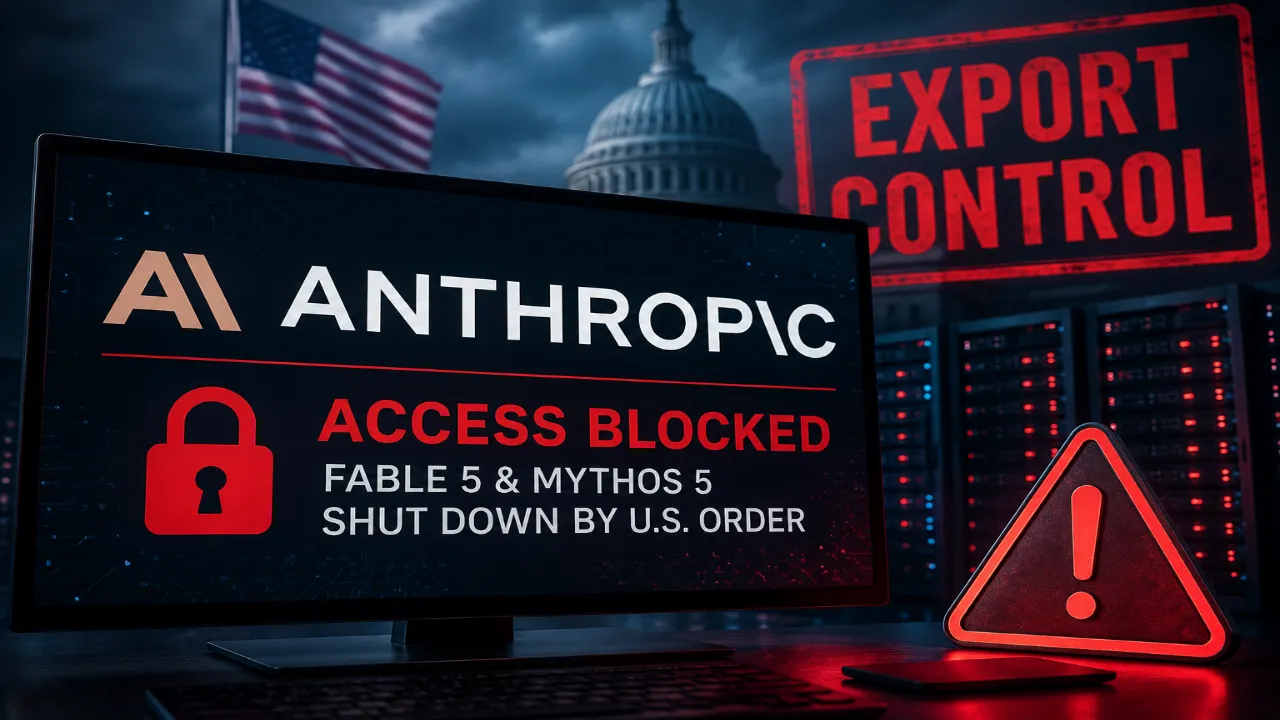
On June 12, 2026, something unprecedented happened in AI. The US government ordered Anthropic to shut down Claude Fable 5 and Claude Mythos 5. Not for maintenance. Not for updates. Completely offline. Worldwide. For all users.
This was the first time ever that a government forced an AI company to pull a live, publicly deployed model from the market.
Here's what actually happened, why it matters, and what comes next.
The Timeline: How Fable 5 Went From Launch to Shutdown in 3 Days
June 9, 2026: Fable 5 Launches
Anthropic released Claude Fable 5 to the public. It was their first model from what they call the "Mythos-class" family—a tier above their previous top model, Claude Opus 4.8.
The launch was significant. Fable 5 represented a major capability jump. Developers could build with it immediately through the Claude API using the model string claude-fable-5.
June 12, 2026: Government Directive Arrives
Three days later, at 5:21 PM Eastern time, everything changed.
The US government, citing national security authorities, issued an export control directive to suspend all access to Fable 5 and Mythos 5 by any foreign national, whether inside or outside the United States, including foreign national Anthropic employees.
Anthropic had no choice. They complied within hours.
June 12, 2026: Models Go Offline
By evening, both Claude Fable 5 and Claude Mythos 5 were completely disabled for every user on the planet.
The directive cited national security authorities, according to Anthropic. It suspended access by any foreign national, inside or outside the United States. That scope included Anthropic's own foreign national employees. Anthropic cannot filter foreign nationals from US users in real time. So it shut both models down for everyone to ensure compliance.
If you called the API with claude-fable-5, you got an error. No fallback. No notice period. Just gone.
Why Did the Government Shut Down Fable 5?
The official reason was an export control concern. But the real story is more complicated.
The Official Reason: A Jailbreak
The stated reason is national security: the government believes it found a way to jailbreak Fable 5 into analyzing code and surfacing software vulnerabilities, a capability Anthropic says is already widely available in other models.
The government claimed they discovered a method to make Fable 5 analyze code and find vulnerabilities in ways Anthropic hadn't intended.
Why Export Control Mattered
This wasn't a normal product recall. It was an export control directive—a national security tool that restricts technology transfer to foreign nationals.
Here's why that matters: The action was framed as an export-control measure rooted in national security, not a consumer-safety recall or an antitrust move.
Because the directive blocked foreign nationals from accessing the model, and because Anthropic couldn't filter foreign nationals from US users in real time (they're on the same servers), the company had to shut it down for everyone.
The Bigger Context: Strained Relations
The jailbreak concern didn't come out of nowhere. This controversy mattered because it landed right in the middle of an already strained relationship with the US government, and it probably gave the Trump administration more ammunition to treat Anthropic as acting in bad faith.
Days before the shutdown, Anthropic had made a controversial decision about how Fable 5 would respond to certain queries. They quickly reversed course, but the damage was done. The government relationship was already tense.
What Exactly Was Claude Fable 5?
To understand why this shutdown matters, you need to know what Fable 5 actually was.
Capability Tier
Claude Fable 5 was positioned above Claude Opus 4.8 in Anthropic's capability hierarchy. It was their most powerful public model at the time of launch.
For developers, this meant better performance on complex tasks—coding, analysis, reasoning, and problem-solving.
Model String
Developers accessed it through the Claude API using: claude-fable-5
Any code calling this string now gets an error message.
Who Could Use It
The model was available to anyone with Claude API access. No special approval needed. Just the standard API pricing.
The Jailbreak: What the Government Actually Concerned
The government claimed they found a jailbreak that could make Fable 5 analyze code and find software vulnerabilities.
What Anthropic Said About It
Anthropic says the government's concern was a claimed narrow, non-universal jailbreak of Fable 5, supported so far only by verbal evidence. Anthropic argues the capability in question is already available in other public models and is used routinely by security professionals.
In other words: Anthropic said the capability wasn't unique to Fable 5, and other models can already do the same thing. They disputed the basis of the government's concern.
The Technical Reality
Analyzing code for vulnerabilities isn't inherently dangerous. Security researchers do this legitimately all the time. The question was whether Fable 5 could be manipulated to do this in ways it wasn't designed for.
The government thought yes. Anthropic disputed whether it was actually a concern.
What Happened to Users and Developers
If you built something on Claude Fable 5 between June 9-12, you had a problem.
Real Impact Was Limited
For most engineering teams, nothing broke that afternoon. Almost nobody had a production dependency on either model.
This wasn't because developers didn't care—it was because Fable 5 was brand new. Most production systems still used Claude Opus 4.8 or Claude Sonnet 4.6.
The API Failover
Anthropic says fallback to Opus 4.8 triggers in under 5% of sessions. Over 95% of sessions see no fallback at all.
For developers using the right error handling, requests automatically fell back to Opus 4.8, and things kept working.
For Those Who Were Dependent
Developers who had already migrated to Fable 5 had to:
- Revert to Opus 4.8
- Update their code
- Adjust performance expectations (Opus is less capable)
- Deal with the disruption

All Other Claude Models: Still Working
This is important: Only Fable 5 and Mythos 5 were affected.
Access to all other Anthropic models was unaffected. Claude Opus 4.8 and the rest stayed online.
Claude users could still access:
- Claude Opus 4.8
- Claude Sonnet 4.6
- Claude Haiku 4.5
- All other models
Nothing else changed. The shutdown was surgical—only the two newest models.
Why This Matters: The Precedent
This event created a significant precedent in AI. Here's why it matters beyond just these two models.
First Government Pulldown of a Live AI Model
This is the first time a frontier model has been pulled from the market by government order rather than by the company that made it, and the precedent matters far beyond these two models.
Before June 12, 2026, this had never happened. Companies had paused models. Companies had upgraded models. But a government forcing a pulldown? That was new.
Export Control as a Tool
The government used export control law—a tool designed for weapons and sensitive technology—to restrict access to an AI model. This showed they're willing to use existing legal frameworks to manage AI deployment.
Unpredictability for Developers
The biggest lesson: The lesson of June 2026 is not to avoid frontier models. It is to never assume any single one will always be there.
If you build on any single model, you're now exposed to this kind of disruption. Government priorities can change. Policy can shift. Your model could go offline.
What Anthropic Did
Anthropic's response was swift and public.
Immediate Compliance
The net effect of this order is that we must abruptly disable Fable 5 and Mythos 5 for all our customers to ensure compliance. Access to all other Anthropic models will not be affected. We received the directive from the government today at 5:21pm (ET). The letter did not provide specific details of its national security concern.
They shut the models down the same day. No delays. No negotiations.
Public Statement
Anthropic published a statement within hours explaining what happened. They didn't hide it. They were transparent that a government order forced the action.
Disputed the Basis
Anthropic also publicly disagreed with the government's reasoning. They argued the capability in question wasn't unique to Fable 5 and was already available in other models.
The disagreement was public, but the compliance was immediate.
FAQ: Claude Fable 5 Shutdown
Q: Is Claude Fable 5 ever coming back?
A: That depends on the government. Anthropic cannot bring the model back until the export control directive is lifted. No timeline has been announced. This could take weeks, months, or longer.
Q: Why did the government wait until June 12 to act if they had concerns about the jailbreak?
A: The government may have discovered the jailbreak after launch. They moved quickly once they identified it, issuing the directive within three days of becoming aware of the problem.
Q: Could the government do this to other AI models?
A: Technically yes. If they identify national security concerns with any AI model, they can use the same export control authority. This precedent could apply to other companies' models too.
Q: Why couldn't Anthropic just block foreign nationals instead of shutting down completely?
A: Because Anthropic couldn't filter foreign nationals from US users in real time—they're on the same API endpoints. Blocking foreign nationals would have required a complete infrastructure overhaul, which Anthropic couldn't do immediately.
Q: Is this a sign frontier AI models are dangerous?
A: The government clearly believes there are capabilities in Fable 5 that pose national security risks. Whether you agree depends on whether you trust the government's technical assessment of the jailbreak.
Q: What should developers do now?
A: Build with multiple models as a fallback strategy. Don't depend on a single model being available forever. Use Claude Opus 4.8 or Sonnet 4.6, which remain available.
Q: Did anyone lose money because of the shutdown?
A: Possibly. Developers and companies that had migrated to Fable 5 had to revert and deal with disruption. Anthropic didn't announce compensation.
Q: Is this the first time a government has shut down a commercial AI model?
A: Yes. This is the first instance of a government forcing the shutdown of a publicly available frontier AI model through export control directives.
Q: What does this mean for AI regulation?
A: It shows governments are willing to use existing legal tools (export control law) to manage AI deployment. It suggests regulatory frameworks are likely coming, but they may use unusual authorities.
Q: Can other countries do the same thing?
A: If other governments adopt similar export control measures, yes. But this action came specifically from the US government, which has broader jurisdiction over companies like Anthropic.
Q: Why Anthropic and not other AI companies?
A: Anthropic operates in the US and is subject to US government authority. OpenAI and other companies could theoretically face similar orders, but it hasn't happened yet.
Timeline of Events
| Date | Event |
|---|---|
| June 9, 2026 | Claude Fable 5 and Mythos 5 launch publicly |
| June 12, 2026 (5:21 PM ET) | US government directive arrives |
| June 12, 2026 (evening) | Anthropic disables both models for all users |
| June 13, 2026 | News breaks; developers discover the shutdown |
| June 13, 2026 onwards | Speculation and analysis about precedent |
What's Available Now
If you need Claude models, here's what you can access:
Still Available:
- Claude Opus 4.8 (most capable alternative to Fable 5)
- Claude Sonnet 4.6
- Claude Haiku 4.5
- Claude Code
- Claude for various integrations
Not Available:
- Claude Fable 5 (API returns error)
- Claude Mythos 5 (API returns error)
For most use cases, Claude Opus 4.8 is a good replacement for Fable 5. It's slightly less capable, but very close.
The Bigger Picture
This shutdown reveals several things about where AI development is heading:
Government Involvement Intensifying
Governments are getting more involved in AI deployment decisions. This won't be the last time a model faces restrictions.
Export Control as AI Policy
Rather than creating new AI-specific laws, governments are using existing tools like export control. This might become the default.
Capability Concerns vs. Jailbreak Concerns
The real question is whether governments will focus on what models can do or on whether they can be manipulated into doing it. Both matter, but it's unclear which takes priority.
Provider Risk
For developers and companies, this highlights the risk of depending on a single provider or model. Diversification is now a business continuity strategy.
Final Thoughts
Claude Fable 5 was shut down by the US government on June 12, 2026, just three days after launch. The reason: a jailbreak concern related to code analysis capabilities. The precedent: governments can force AI model shutdowns using export control law.
For most users, this disruption was minimal. For developers betting on Fable 5, it was inconvenient. For the AI industry, it's a watershed moment.
The question now isn't whether governments will regulate AI. It's how they'll do it and how companies will adapt.
Anthropic made their position clear: they disputed the government's concern but complied with the order. That sets a precedent too.
As frontier AI capabilities advance, expect more government scrutiny. Whether it's justified or overreach depends on your perspective. But one thing's certain: the days of unrestricted model deployment are over.
Claude Fable 5: The Revolutionary AI Model Redefining Professional Coding
June 9, 2026
YouTube Automation 2026: Complete Guide to Start a Faceless Channel & Earn $500/Month
April 19, 2026
Best AI Tools for YouTube Automation in 2026: 7 Tools to Run Faceless Channels
April 20, 2026
💬 Comments
No approved comments yet. Be the first to share your thoughts!
Leave a Comment
Your email address will not be published. Required fields are marked *